|
 |
|
 |
Monitoring Programs
 |
|
SEAFLOOR
HABITAT RECOVERY MONITORING PROGRAM
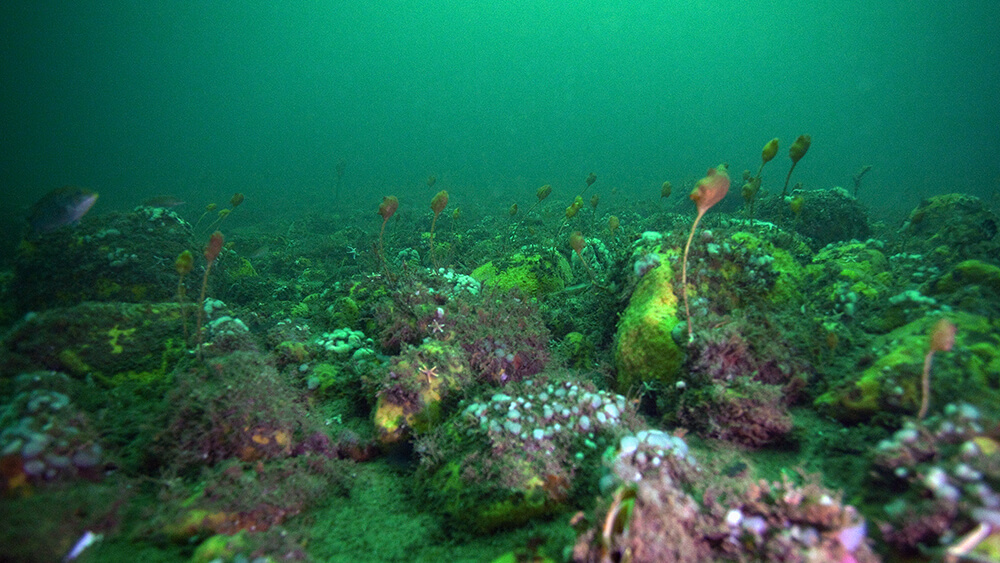
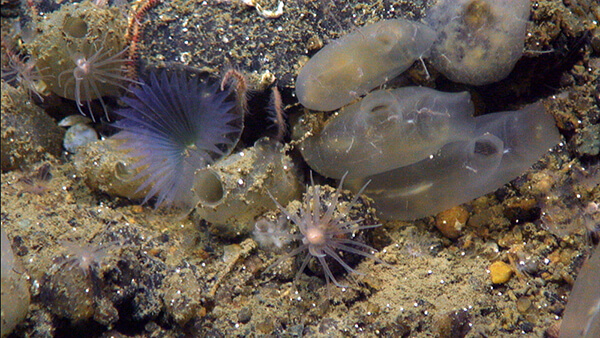
The southwest corner of the Western Gulf of Maine
Closed Area (WGoMCA), which overlaps the SBNMS for
a total of 132 square nautical miles, or 22% of
the Sanctuary, presented the opportunity to study
seafloor habitat recovery following anthropogenic
disturbance by bottom-contact mobile fishing gear
(such as trawls and dredges).
|
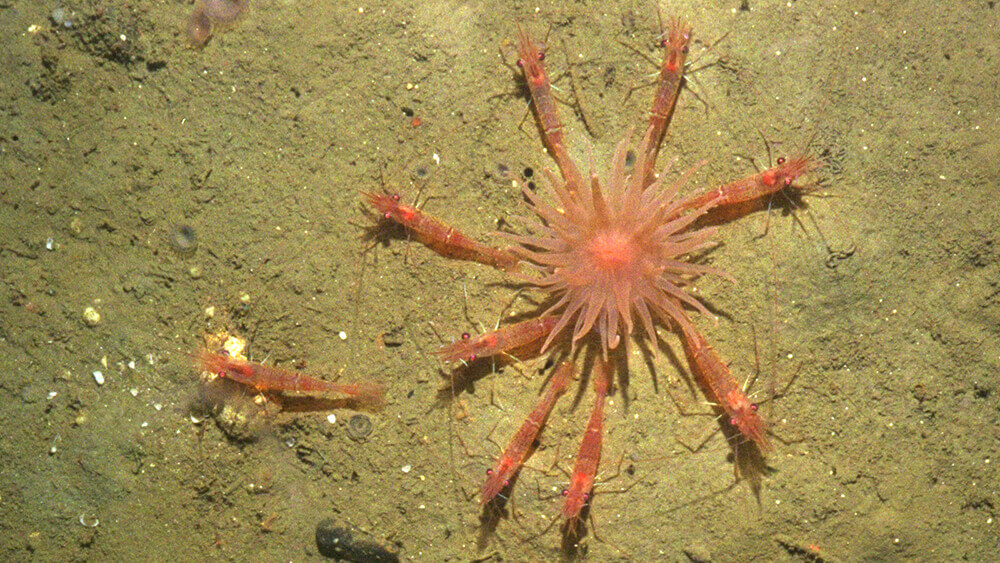
The
Seafloor Habitat Recovery Monitoring Project (SHRMP) was
initiated in April 1998, one week prior to the closure
of the WGoMCA, to investigate the recovery rates in the
SBNMS following impacts from fishing. In August 2001,
several sites along the route of a new fiber optic cable
and in adjacent areas were added to the existing SHRMP
stations to investigate the recovery of seafloor habitats
following the laying of the cable by plow. The SHRMP is
a collaborative effort between the SBNMS and scientists
at the Pfleger Institute of Environmental Research (PIER),
the National Undersea Research Center at the University
of Connecticut (NURC-UCONN), the US Geological Survey
in Woods Hole, Massachusetts, the University of Maine,
and Brown University (Brown participated from 2001-2003),
with database management provided by Perot Systems.
|
|
 |
In
its 2003 report, the US National Research Council's
(NRC's) Committee on the Potential Impacts of Ambient
Noise in the Ocean on Marine Mammals recommended
the establishment of "noise budgets",
defined as the sum of the relative contributions
made by identified sound sources to the total sound
field, for marine areas of concern (National Research
Council of the National Academies, 2003). After
a two-week pilot project in 2004, in January 2006,
a collaborative group of researchers from the SBNMS,
NOAA Fisheries (Northeast Science Center and Regional
Office) and Cornell University's Bioacoustics Research
Program began a year-long passive acoustic monitoring
project to characterize the Sanctuary's noise budget
between 0-1000 Hz. Acoustic data from this research
will be used to study acoustic densities and distributions
of vocalizing whales within the SBNMS, as well as
to examine the relative inputs of noise from vessels
and other sources.
|
|
 |
|
|
|
WATER
QUALITY MONITORING AND ASSESSMENT
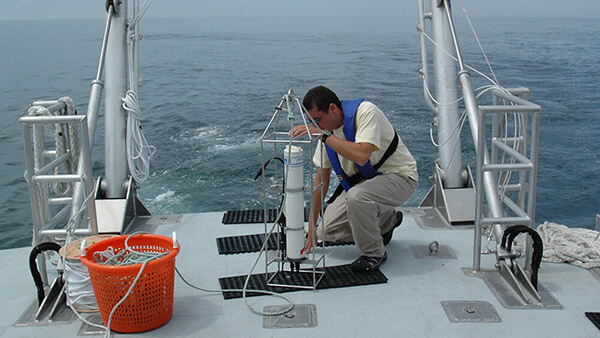
Understanding water quality in the SBNMS is
important to overall management of the biological
resources within the sanctuary.
|
While
the Massachusetts Water Resources Authority (MWRA)
in conjunction with its Harbor and Outfall Monitoring
program supports some water quality monitoring with
the sanctuary, the spatial and temporal coverage
of the effort is limited to six surveys on the western
side only. Concern about possible effects of the
MWRA outfall in Massachusetts Bay prompted the SBNMS
to pursue an expanded sampling program in the sanctuary
after the outfall went online in September 2000.
Under a contract with the SBNMS, Battelle has been
sampling additional stations in the sanctuary since
late summer of 2001. In addition to providing data
to assess possible outfall effects, sampling has
provided new water quality information about the
eastern boundary of the sanctuary.
|
 |
|
|
 |