

Passive Acoustics
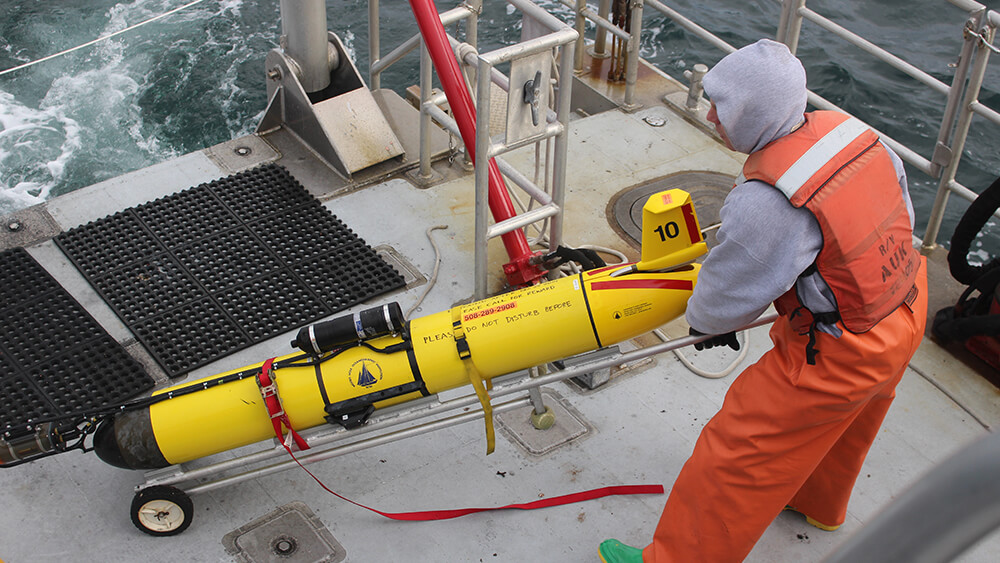
Work in the sanctuary focuses on understanding levels of background underwater sound and impacts to marine animals exposed to sources of sound produced by human activities, such as commercial shipping. This work entails listening, or passive acoustic monitoring, in which hydrophones (underwater microphones) are placed in the ocean to collect sound information for study. Some systems send information to researchers in near real time based on what they hear while others record and store their data over days, weeks, or months which then is recovered and analyzed. Additional studies use programmed autonomous vehicles, such as gliders, to record data over specified paths in areas of interest (often in a lawnmower-like pattern).
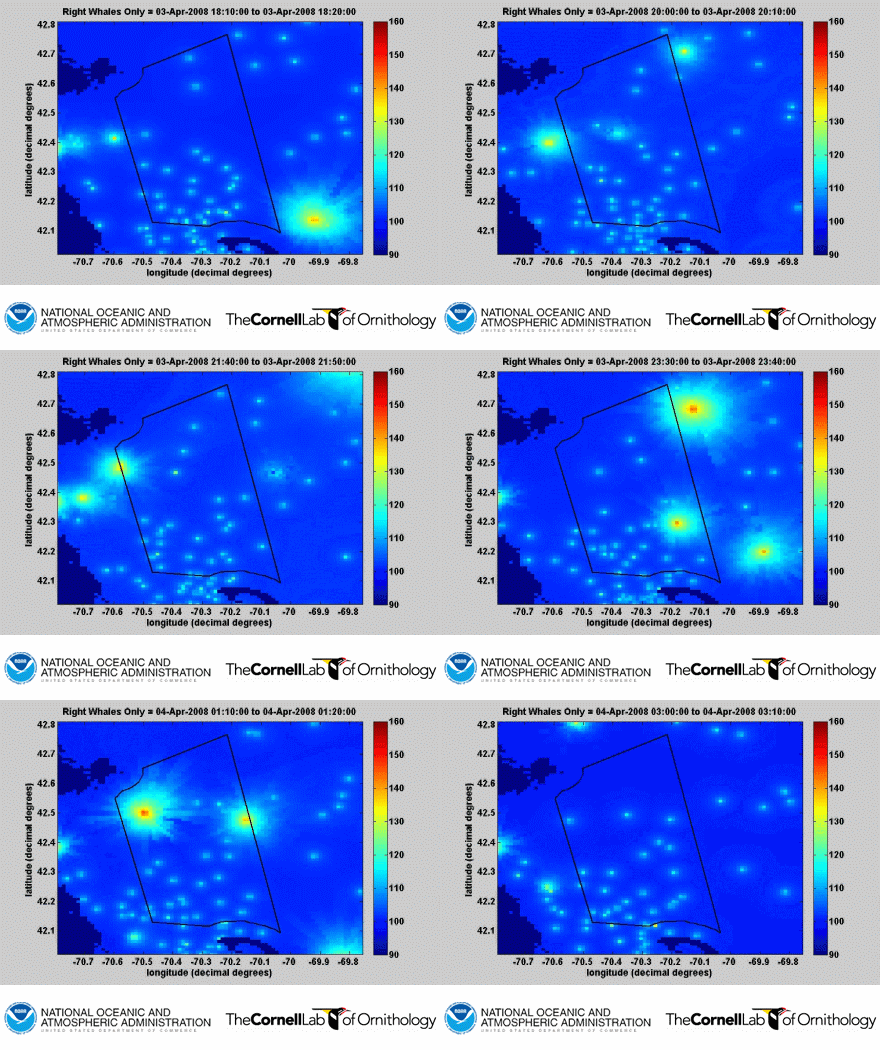
See how ship sounds are masking right whale upcalls (ships are the larger splotches and the whales are represented by the small dots.
Additional Information
SanctSound
NOAA's Office of National Marine Sanctuaries and the U.S. Navy, along with many scientific partners, are engaged in a multi-year effort to monitor underwater sound within the National Marine Sanctuary System. In addition to Stellwagen Bank, the other national marine sanctuaries and monuments in the study are Gray's Reef and Florida Keys on the East Coast, Olympic Coast, Monterey Bay, and Channel Islands on the West Coast, and in the Pacific region Hawaiian Islands Humpback Whale National Marine Sanctuary and Papahānaumokuākea Marine National Monument.
SanctSound Online Resources from the sanctuary and partners
Gliders Listen for Whales and Fish
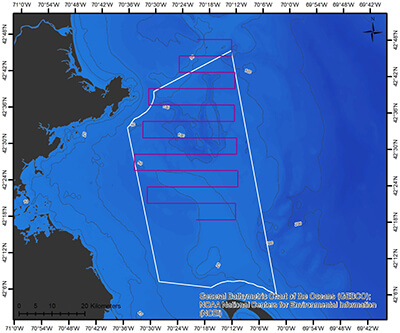
Glider surveys with real-time acoustics are taking place within Stellwagen Bank National Marine Sanctuary in the winters of 2020 and 2021 as part of the SanctSound project. These surveys are providing real-time updates on the winter-time presence of critically endangered North Atlantic right whales and other vocally-active baleen whales, such as humpbacks, sei, and fin whales. Whale detections can be viewed in real time on Whale Alert. Their recordings are also being used to study winter spawning activity for Atlantic haddock and Atlantic cod, two important fish species in the sanctuary that make sounds as part of their reproductive activity. Woods Hole Oceanographic Institution and NOAA Fisheries' Northeast Fisheries Science Center are project partners.
Read more about listening to right whales in the Gulf of Maine.
Track the gliders! Past missions are archived. This link is for the mission that ended in May 2020. Future mission data will be provided in real time.
NOAA/NPS Ocean Noise Reference Station Network
This unique national network of hydrophones is a collaborative effort between NOAA and the National Park Service. The project is dedicated to establishing and collecting consistent and comparable long-term underwater acoustic data sets covering all major regions of U.S. waters. The NOAA components consist of OAR's Pacific Marine Environmental Laboratory (PMEL), all National Marine Fisheries Service Science Centers, and five sites within the National Marine Sanctuary System. Stellwagen Bank National Marine Sanctuary serves as one of the shallow water listening stations
The sanctuary was included in a recent scientific paper, "Comparing the Underwater Soundscapes of Four U.S. National Parks and Marine Sanctuaries.".
Hear from a former Dr. Nancy Foster scholar, Dr. Samara Haver, who studies this subject.
Early Studies in Underwater Noise Levels and Sound-Producing Fish
From 1996 through 1999, researchers gathered data about background underwater noise levels within the sanctuary. In addition, passive acoustic surveys in 2001 through 2005 gathered information on sound-producing fish. Subsequently, in 2006, researchers undertook a year-long monitoring project to characterize the sanctuary's low frequency "noise budget." This led to estimates of the amount of noise that was occuring at the same frequencies used by vocally-active marine animals that were made by large commercial vessels. A further study from 2007 to 2010 mapped the distributions of sound made by vocalizing marine animals and the noise produced by vessels and quantified possible changes in the ability of animals to communicate when background noise levels are high.
Right Whale Listening Network
After the shift in the Boston Shipping Lanes and the decision to build two Deepwater Liquid Natural Gas (LNG) import terminals just outside of the sanctuary boundary, consultations between NOAA and the federal agencies regulating the ports (the U.S. Coast Guard and the U.S. Maritime Administration) resulted in a plan to help protect endangered North Atlantic right whales from added vessel traffic. The plan was to place ten real-time listening buoys between the traffic lanes that pass through the sanctuary and on towards Boston. Any detections of right whale upcalls (a social call for this species) would be verified and then warnings broadcast to LNG vessels and the broader seagoing public via web-based platforms. Verified calls are used to trigger speed reductions for LNG carriers serving the ports. For more information about the listening network, visit the Cornell Bioacoustic Portal or Whale Alert.