

History of the CSS Bibb
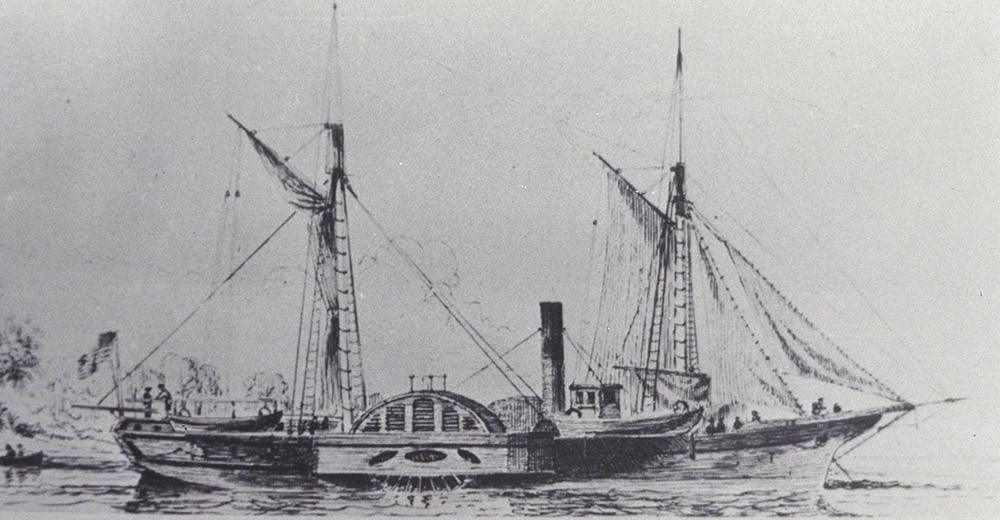
The Coast Survey steamer Bibb, the vessel which carried Lt. Henry Stellwagen and his crew around Massachusetts Bay as they mapped the major banks, had an interesting history in its own right. Originally built for the U.S. Revenue Marine Service, a forerunner of the Coast Guard, Bibb never quite lived up to the expectations. From its earliest days, it was beset by mechanical problems. The letters from Stellwagen to Alexander Bache, superintendent of the Coast Survey, are filled with references to needed repairs and delays due to engine problems.
In an article on the Revenue Service's first steam cutters (in The American Neptune, Winter 1992), Robert M. Browning, Jr., the Coast Guard's chief historian, wrote: "The quest for technology is as old as mankind itself. History is filled with great inventions and their impact on society. The failures, however, are often forgotten or dismissed. In the 1840s, with steam propulsion increasing in popularity as a method to propel ships, the U.S. Revenue Marine Service built eight steam vessels. Most were built with innovative machinery and propulsion systems. Nonetheless, the building program was a disaster. None of the ships worked well, they were exorbitantly expensive, and all were converted, sold or transferred to other services within several years of their commissioning. The quest for innovation and progress, in this case, ended in complete failure."
Bibb was named for George M. Bibb, the Secretary of the Treasury in 1844. It and Spencer, Dallas, and McLane were designed to use a horizontal paddle wheel patented by William W. Hunter, a Lieutenant in the U.S. Navy. Two other vessels, Jefferson and Legare, contracted at the same time (1843) were to use a screw propeller designed by Swedish inventor John Ericsson. The final two vessels, Polk and Walker, used side-wheel propulsion systems.
Bibb was launched on April 10, 1845. Its sea trials were a complete failure, with the ship developing a major leak, leading the captain to haul it up on a beach to prevent sinking. According to the Browning article, Bibb's Hunter wheel was a technological anomaly. He noted, "Everyone failed to take into account the inefficient nature of the Hunter wheel, where as much as 50 to 75 percent of the propulsion power was lost pushing the water around the wheel wells." In addition, the hull design "had little structural strength and compromised the ship's stability and sailing qualities. The designers of the steamers attempted to utilize a combination of sail and steam propulsion, with the final product being a combination of the bad qualities of each." The ship was towed in for overhaul where it was refitted to side-wheel propulsion.
Bibb was called up for service to protect the coastline in the Gulf of Mexico during the war with Mexico. The Browning article notes that it lasted in service for four months and then went back to Boston. Captain Winslow Foster commented about Bibb "that never a vessel left port so badly qualified to encounter a sea." He added that "This might have been a good useful vessel, of fair speed, had any nautical skill been employed, when she had prepared for the change in her propulsion."
Bibb was transferred to the Coast Survey in 1847. During its service with the Coast Survey, it saw duty in New England, where it was used to map potential harbors and lighthouse positions (and was the vessel from which Stellwagen mapped his offshore bank). Other survey locations included the Chesapeake area and the Florida Keys, including the waters around the Dry Tortugas (the southernmost portion of the Florida Keys, now also a national marine sanctuary). Bibb was called up for war duty during the Civil War where it was part of the Union's naval blockade of the Charleston (South Carolina) harbor. It took a hit from an underwater charge but did not suffer significant damage. Bibb was decommissioned in 1879.